
AI automation services are rapidly transforming how companies operate. Whether you run a small business, an ecommerce store or a large enterprise, automation helps you eliminate repetitive tasks, improve accuracy, and accelerate growth with far fewer resources.
This guide explains what AI automation services are, how they work, why businesses need them and how to choose the right solution for long term success.

AI automation services combine artificial intelligence with workflow automation to execute business tasks without manual intervention.
In simple words, you let smart systems handle routine work so your team can focus on decisions, strategy and customer experience.
These services typically use a mix of:
AI automation can support almost any business function from customer service to marketing to operations.
Modern businesses operate in a fast, competitive and data driven world. Customers expect instant replies.
Teams are multitasking across multiple tools. Leaders want accuracy and speed without raising costs.
AI automation bridges this gap.
Here are the core benefits:
Automating repetitive tasks reduces labor costs,minimizes errors and shortens processing times.
AI handles tasks 24/7 with no breaks,no delays,no fatigue. It works consistently and accurately.
AI chatbots,automated emails and personalized user journeys deliver quick support and real time engagement.
AI analyzes large amounts of data and provides insights your team may not detect manually.
You can scale operations orders,communication without hiring large teams.
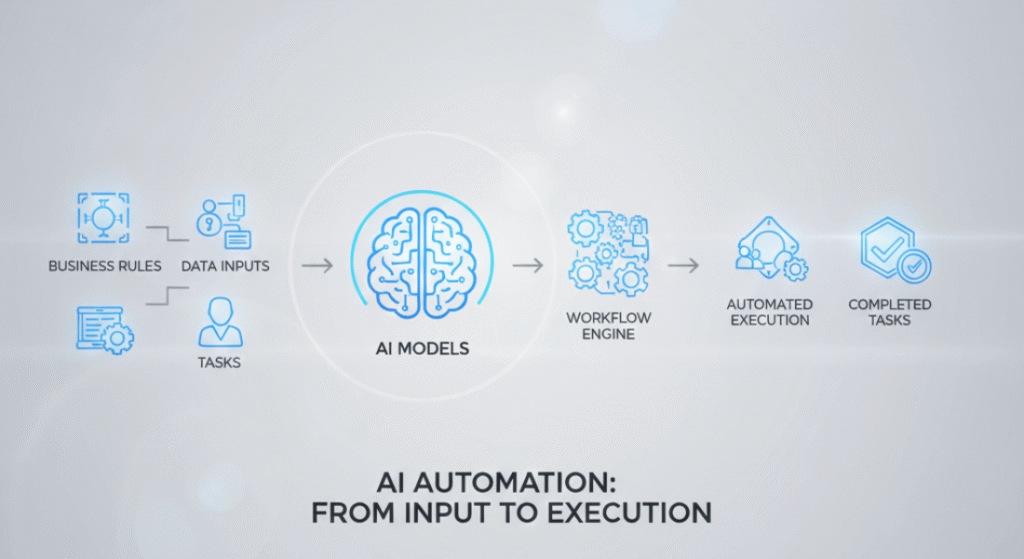
AI automation works by taking business rules, data inputs and tasks and then executing them automatically using AI models and workflow engines.
Here is the simplified flow:
Input Data:
Emails, messages, forms, CRM entries, transactions, customer queries.
AI Understanding:
NLP interprets language, ML models identify patterns, predictive tools forecast outcomes.
Automated Action:
Sending emails,updating CRM fields,classifying data,generating reports,answering chat queries or triggering workflows.
Continuous Improvement:
AI learns from user behavior and improves accuracy over time.
When choosing an AI automation provider or building in house workflows, evaluate the following:
The system must accurately understand human language, including context and intent. It should also generate clear, natural and human like text for effective communication.
Ensure seamless integration with CRM, CMS, accounting tools, HR software and communication applications to enable smooth data flow and unified operations across the organization.
Look for drag and drop or low code tools that enable easy automation without requiring heavy development, allowing faster implementation and greater flexibility for non technical teams.
Use dashboards to monitor performance, track activity logs and measure success rates, ensuring visibility, control and continuous optimization of automated processes.
The system should be scalable and flexible,allowing it to grow and adapt seamlessly as your business needs evolve.
Ensure compliance with GDPR and ISO standards, supported by strong data encryption to protect sensitive information and maintain regulatory trust.
The best AI automation solution depends on:
Most businesses start with simple automations such as email replies, CRM updates, chatbot deployments or invoicing. Over time, they scale into complete end to end workflow automation across departments.

AI automation drives revenue growth by streamlining operations, reducing costs, and enabling faster decision making.
By automating repetitive workflows, businesses free teams to focus on sales, innovation and customer engagement.
AI powered analytics improve lead targeting, pricing strategies, and demand forecasting, while intelligent chatbots enhance customer experience.
Together, these capabilities increase conversions, boost customer lifetime value and support scalable, sustainable business growth.
AI automation does more than streamline operations it directly impacts revenue:
Faster lead responses are achieved through automated replies, ensuring no opportunities are missed and prospects are engaged immediately.
Personalized marketing uses AI to create customer specific messages, increasing engagement and driving higher conversion rates.
Automation allows teams to focus on innovation, client management and sales, boosting productivity and strategic impact.
Automation reduces errors in finance, logistics and communication, ensuring greater accuracy and operational efficiency.
AI remembers customer preferences and delivers consistent support.
To ensure long term success, follow these steps:
Start small and scale gradually by implementing 2 to 3 high impact automations first, then expanding as efficiency and confidence grow.
Use cloud based,no code platforms,as modern automation tools minimize complexity and accelerate deployment.
Human oversight remains essential for monitoring ,fine tuning and optimizing automated processes effectively.
Example KPIs include response time,cost savings,accuracy rate and process completion speed to measure automation effectiveness.
AI continuously enhances efficiency, but business processes evolve, requiring regular updates. Review and refine automation monthly to stay aligned with changing workflows.
AI automation is evolving rapidly. Here are emerging trends:
AI driven systems designed to perform complex,multi step tasks without human intervention, making decisions and adapting as needed.
Integrates AI,machine learning and Robotic Process Automation (RPA) to achieve deeper operational efficiencies and smarter workflows.
Customized models designed for healthcare, finance, logistics, real estate and legal sectors to address unique operational needs.
An increasing number of users will initiate workflows through voice commands, enhancing hands free efficiency.
Predictive Automation: AI will anticipate tasks before they arise and execute them automatically, streamlining operations and saving time.
AI automation services are no longer optional, they are essential for modernization, cost efficiency and competitive advantage.
Companies that integrate AI solutions see significant improvements in productivity, accuracy and scalability.
From customer service to marketing to finance,automation reshapes the entire business ecosystem.
Whether you are a startup or an established enterprise, investing in AI automation today positions your organization for long term growth, stronger customer experiences and operational excellence.
AI automation solves problems like manual workload, slow response times, high labor costs, workflow bottlenecks, data errors and inconsistent customer experiences. It removes repetitive tasks and ensures that business operations continue smoothly 24/7 with higher accuracy and reliability.
Costs vary based on complexity, tools used and the number of automated processes. Small businesses may pay a few hundred dollars monthly, while enterprises may invest thousands. The real value comes from the ROI time saved, errors reduced and revenue increased.
Not entirely. AI excels at structured, repetitive and data driven tasks. However, human judgment, creativity, strategic decision making and emotional intelligence remain essential. AI automation supports humans, it does not replace them entirely.
Yes, when implemented correctly. Enterprise grade AI tools follow strict security standards, encryption and data compliance measures. However, businesses must choose trustworthy platforms and enforce best practices for privacy and governance.
Implementation timelines depend on complexity. Simple automation can be completed in 1 to 7 days, moderate workflows take 2 to 4 weeks and enterprise level processes may require 1 to 3 months. The final timeline is driven by the number of workflows, integration needs and training requirements.