
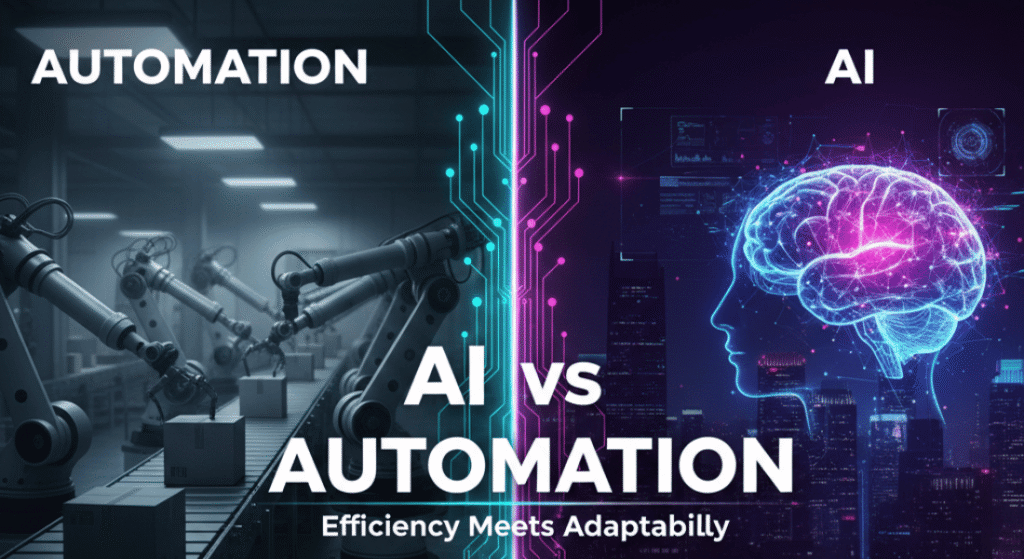
In the era of digital transformation, businesses are increasingly relying on technology to streamline operations and gain a competitive edge.
Two concepts frequently mentioned in this context are Ai vs Automation. While often used interchangeably, they are fundamentally different and understanding the distinction is crucial for businesses looking to implement the right technology for efficiency, productivity and growth.
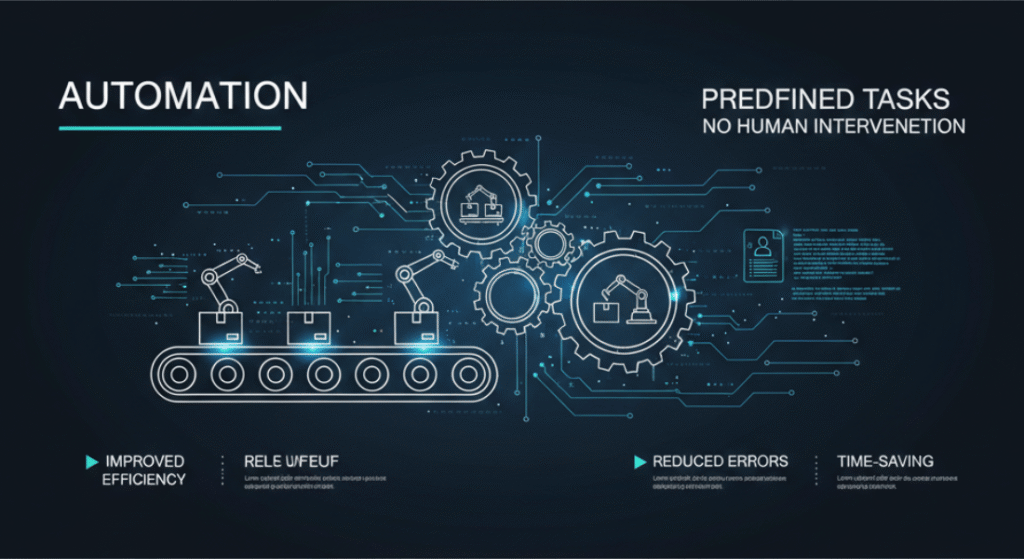
Automation refers to technology that performs predefined tasks without the need for human intervention.
It relies on rules and instructions provided by humans and executes them consistently every time.
Automation is primarily focused on improving efficiency, reducing errors and saving time in repetitive processes.
Artificial Intelligence is the ability of machines to mimic human intelligence. Unlike automation, which follows rigid rules, AI learns from data, adapts to changing circumstances and makes decisions based on patterns and insights.
AI is especially valuable in situations where tasks are complex, dynamic or require predictive capabilities.
AI is best suited for tasks that require learning, judgment and adaptability rather than simple repetition.
Understanding the distinction between AI and automation is critical for businesses to make informed technology investments.
| Feature | Automation | Artificial Intelligence |
| Function | Executes predefined tasks | Learns and makes decisions |
| Flexibility | Low | High |
| Decision making | Rule based | Data driven |
| Adaptability | Limited | Continually improves |
| Best for | Repetitive processes | Complex, dynamic tasks |
| Examples | Invoice generation, workflow triggers | Chatbots, predictive analytics |
In essence, automation executes, while AI interprets and improves.
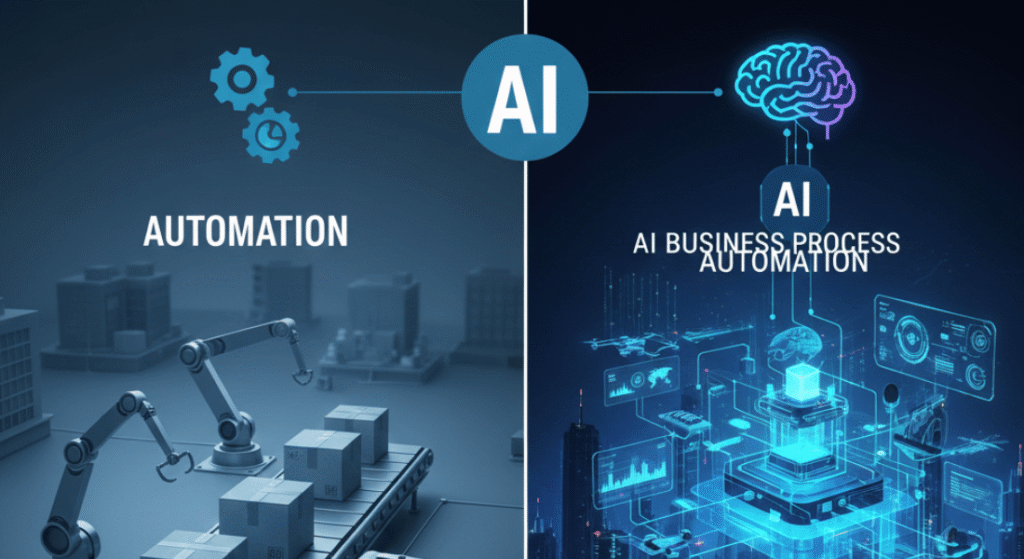
Businesses that fail to differentiate between AI and automation often misallocate resources, implementing solutions that either do not scale or fail to address complex business problems. By understanding the strengths of each, organizations can:
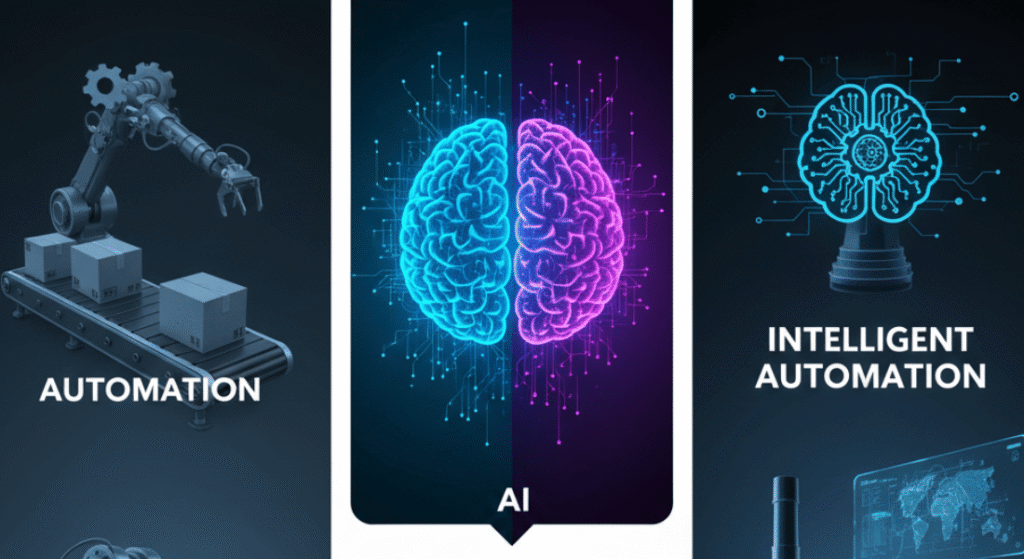
While automation and AI are different, they work best together. When AI is applied to automation, it creates intelligent automation, which combines the efficiency of repetitive task management with the adaptability of machine learning.
Example Scenario:
This synergy allows businesses to execute complex workflows at scale while leveraging insights for better outcomes.
The answer depends on the specific needs and maturity of the organization.
Initially, automation may seem cheaper because it is simpler to implement and maintain. However, AI offers long-term strategic value by:
The highest ROI often comes from AI enhanced automation, where businesses reduce manual labor and gain actionable intelligence simultaneously.
Is automation a part of AI?
No. Automation operates on fixed rules, while AI enhances processes with learning, adaptability and intelligent decision making.
Does AI replace automation?
No. AI does not replace automation it augments it, creating smarter, more efficient systems that combine intelligence with execution.
Can AI work without automation?
Yes. AI can analyze data, make decisions, and learn independently, but automation is required to implement these decisions at scale.
Should small businesses use AI or automation first?
Small businesses usually begin with automation to streamline repetitive tasks. AI can be introduced later for insights, predictions and smarter workflows.
How do AI and automation work together?
Automation handles repetitive tasks, while AI adds learning, adaptability and predictive insights, making business processes faster and more efficient.
What are the benefits of combining AI with automation?
Combining AI and automation improves accuracy, reduces operational costs, accelerates decision making and enables scalable, intelligent workflows.
Can AI improve existing automated systems?
Yes. AI can analyze automated processes, optimize them, and adapt them over time, making systems smarter and more efficient.
Looking ahead, businesses can expect several trends:
The debate of AI vs automation is not about choosing one over the other. Both have distinct strengths:
By combining both, organizations can build workflows that execute flawlessly, learn continuously and scale effectively.
Businesses that understand this synergy are better positioned for innovation, operational excellence and sustainable growth in an increasingly digital world.