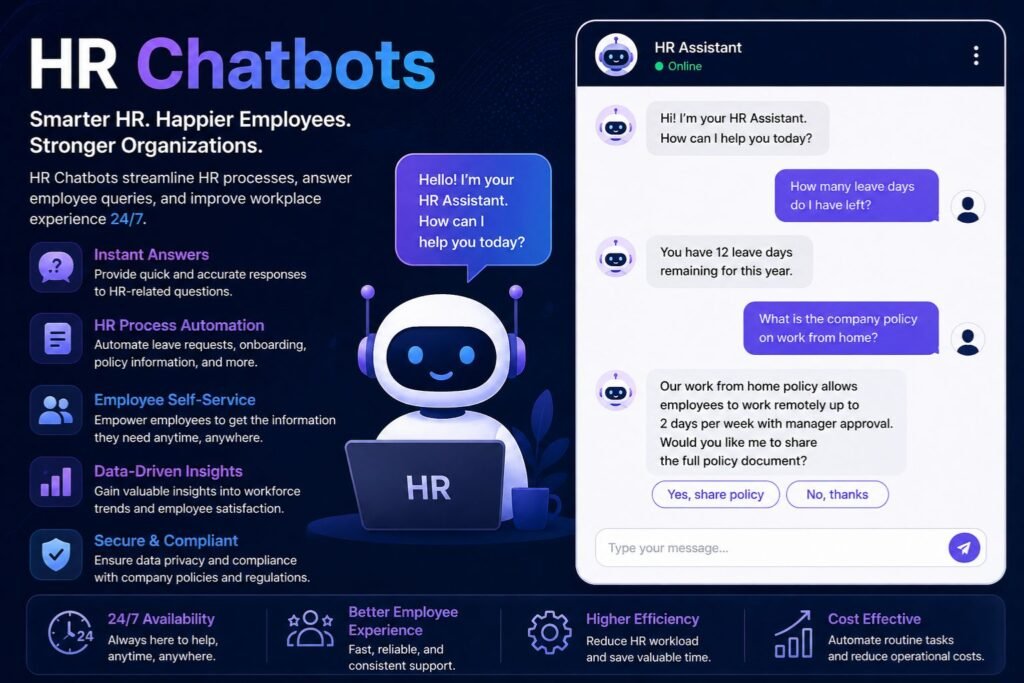
HR operations are becoming increasingly complex as businesses scale and workforce expectations evolve. Organizations now require faster, more efficient, and data-driven ways to manage employee interactions.
Traditional HR teams often struggle with repetitive queries, onboarding processes, and employee support tasks. This creates delays, inefficiencies, and increased operational costs.HR chatbots are intelligent conversational tools designed to automate HR processes, answer employee queries, and streamline workforce management.
In this article, we will explore what hr chatbots means, its importance, benefits, challenges, and practical applications, and how Tecrix.org helps businesses leverage it effectively.
HR chatbots are AI-powered virtual assistants designed to manage common human resource tasks such as answering employee queries, handling leave requests, supporting onboarding, and sharing company policies.
These chatbots use natural language processing to understand questions and provide accurate, real-time responses. They are part of a broader HR automation ecosystem that improves internal communication and reduces manual workload.
Many organizations explore free HR chatbot tools or compare the best available options to enhance their HR processes while keeping costs low.
HR chatbots ensure employees can access support anytime, without waiting for HR personnel.
Routine queries are automated, allowing HR teams to focus on strategic tasks.
Employees receive instant answers, improving satisfaction and productivity.
All HR-related information is available in one place through conversational interfaces.
Using hr chatbots reduces the need for large HR support teams, lowering operational expenses.
Quick and accurate responses enhance engagement and workplace satisfaction.
HR chatbots can handle increasing employee queries without additional resources.
Tasks like leave approvals, FAQs, and policy explanations are automated efficiently.
HR chatbots collect interaction data that can be used to improve HR strategies.
HR chatbots guide new hires through documentation, training schedules, and company policies.
Employees can request leave and check balances through conversational interfaces.
Chatbots instantly answer questions about company rules and regulations.
HR chatbot examples include screening candidates, scheduling interviews, and answering applicant queries.
HR chatbots act as a first point of contact for employee concerns.
Organizations often evaluate the best hr chatbots and platforms before implementation. Some commonly referenced solutions include:
These solutions demonstrate how AI can streamline HR processes across industries.
HR chatbots handle sensitive employee data that must be protected.
Connecting chatbots with existing HR systems can be technically challenging.
Poorly trained chatbots may provide incorrect or incomplete answers.
Employees may require time to adapt to chatbot-based interactions.
Ensure encryption and compliance with data protection standards.
Leverage accurate hr chatbot questions and answers dataset for better performance.
Regularly evaluate chatbot interactions and improve responses.
Connect chatbots with HRMS, payroll, and attendance systems.
Allow seamless transfer to human agents when needed.
| Feature | Traditional HR | HR Chatbots |
|---|---|---|
| Availability | Limited hours | 24/7 |
| Response Time | Delayed | Instant |
| Scalability | Limited | High |
| Cost | High | Optimized |
| Efficiency | Manual | Automated |
Employees spend less time waiting for HR responses and more time on core tasks.
Automation minimizes the need for large HR teams.
Instant support leads to better workplace satisfaction.
Companies using advanced hr chatbots gain efficiency over competitors relying on manual processes.
HR chatbots are transforming how organizations manage employee interactions and internal processes. By automating repetitive tasks, improving response times, and enhancing employee experience, hr chatbots provide a powerful solution for modern HR challenges.
Businesses that adopt HR chatbots gain efficiency, reduce costs, and build a more productive workforce. With the right implementation strategy and expert support, these systems can significantly improve HR operations and deliver long-term value.
HR chatbots are AI-powered assistants that help automate HR tasks like answering employee queries, onboarding, leave requests, and policy guidance.
Popular AI chatbots include ChatGPT, Google Gemini, and Microsoft Copilot for general and professional use.
No, chatbots are legal to use as long as they comply with data protection, privacy laws, and ethical guidelines.
HR tools like Workday and BambooHR are widely used for managing recruitment, payroll, and employee data.
ChatGPT for HR refers to using AI to assist HR tasks such as writing job descriptions, answering employee questions, screening candidates, and automating communication.
They reduce manual workload by handling repetitive queries, improving response time, and allowing HR teams to focus on strategic tasks.