
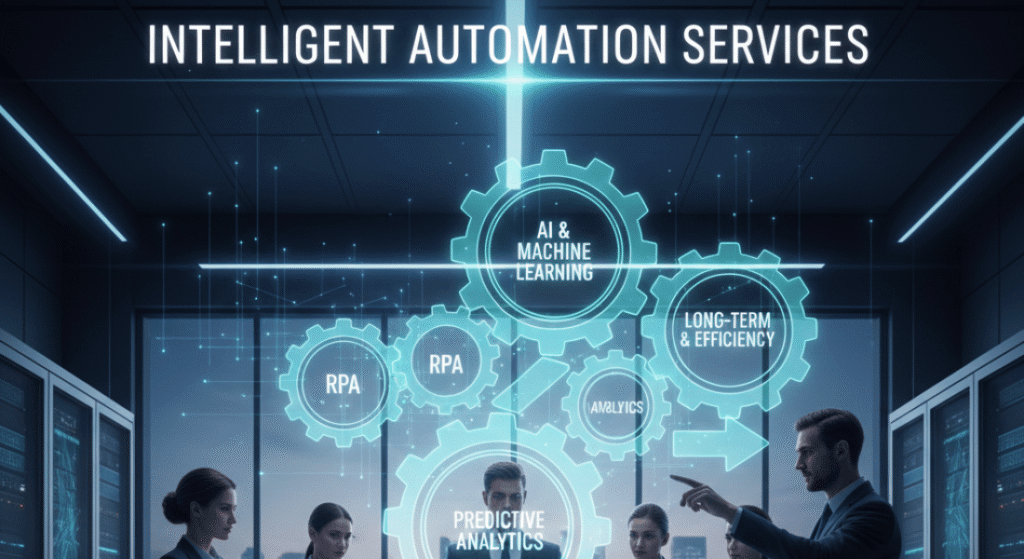
AI and automation have moved far beyond buzzwords. Today, they sit at the center of operational strategy for companies that want to scale without allowing costs, workloads or inefficiencies to hold them back.
Intelligent automation services combine artificial intelligence, machine learning and advanced workflow automation to help businesses operate with significantly higher accuracy, speed and consistency.
If you are exploring how AI and automation can support your next stage of growth, this guide breaks down how intelligent automation works, why it matters and how organizations can deploy it effectively.

Intelligent automation refers to the use of AI powered systems that can learn, adapt and make decisions while executing processes.
Instead of simply automating a series of rules or predictable steps, these systems understand context, interpret data and recommend or take actions based on insights.
In simple terms: it is automation with a brain.
Automation manages repetitive, rules based tasks with consistency and speed, while AI analyzes data, learns patterns and improves outcomes over time.
Together, they create intelligent workflows that are efficient, self improving and capable of managing complex scenarios with minimal human intervention, enabling businesses to scale operations while maintaining accuracy, agility and performance.
Most intelligent automation solutions are built on a combination of:
This layered approach allows organizations to move beyond basic task automation and into strategic, high value optimization.
Across industries, leaders face the same pressures: rising operational costs, increasing customer expectations and the demand for faster delivery cycles.
Intelligent automation addresses all three by optimizing workflows, reducing manual effort, improving service quality and accelerating execution, enabling organizations to operate more efficiently while maintaining competitiveness and customer satisfaction.
Automated workflows operate 24/7 without fatigue, delays or errors. This allows businesses to reduce manual workload while increasing output.
Human mistakes missed entries, slow approvals, outdated data cost organizations thousands of dollars every year. Intelligent automation minimizes these risks by relying on real time data and consistent logic.

Intelligent automation is not a one size fits all solution. Its true value lies in its ability to adapt to diverse workflows, operational structures and business objectives.
When tailored correctly, it aligns with unique processes, enhances efficiency and delivers measurable outcomes that generic automation tools cannot achieve across different industries and use cases.
From invoice handling to onboarding, repetitive processes can be executed instantly and consistently.
AI does not just process data it identifies patterns, flags risks and predicts what may happen next.
For example, automated forecasting systems help sales teams prioritize leads, while predictive maintenance minimizes equipment downtime.
Chatbots, automated ticket routing, sentiment analysis and real time personalization help businesses deliver faster, more relevant customer interactions.
Traditional automation is rule based. It is excellent for predictable, structured processes but fails when exceptions or variations occur.
AI driven automation adapts dynamically as conditions evolve. By learning from historical and real time data, it continuously improves accuracy, optimizes decisions and reduces dependency on manual updates.
This adaptability enables businesses to maintain performance, respond faster to change and scale operations efficiently while minimizing operational risk and human intervention.
Structured environments such as manufacturing lines or fixed data entry tasks continue to benefit from rules-based automation due to their predictability and consistency.
Intelligent automation builds on these existing systems by adding learning and decision making capabilities, enhancing performance and flexibility without disrupting proven processes or requiring complete system replacement.

Implementation quality determines whether automation becomes a strategic asset or an underused tool. Effective execution ensures systems align with business goals, integrate seamlessly with existing workflows and deliver measurable outcomes.
Poor implementation leads to low adoption, inefficiencies and wasted investment, while high quality automation drives scalability, reliability and long term competitive advantage across operations.
Success requires both technology and people:
A thoughtful rollout ensures long term value and minimizes disruption.
Intelligent automation serves organizations of all sizes but the benefits vary based on scale.
SMBs can use automation to reduce overhead, improve customer response times and compete with larger players by improving speed and accuracy.
Enterprises rely on automation to manage complexity: multi department workflows, regulatory requirements, large data volumes and global operations.
Costs vary by scope, but most organizations see rapid ROI because automation significantly reduces manual labor and operational errors.
Simple workflows can be automated in days. Enterprise level solutions may require weeks or months depending on integration needs.
Teams do not need coding expertise. Most modern platforms are designed with user friendly interfaces and guided automation frameworks.
Tecrix.org provides a structured, reliable and expert driven approach to intelligent automation. The team focuses on practical deployment solutions that integrate smoothly, reduce operational overhead and deliver measurable business impact.
Whether you want to automate workflows, streamline customer service or improve decision making,Tecrix.org brings the technical depth and real world experience necessary to implement intelligent automation correctly from day one.
Intelligent automation is no longer just a futuristic concept, it is a practical, results driven strategy that empowers businesses to work smarter, faster and more efficiently.
By combining AI, machine learning and advanced workflow automation, organizations can reduce costs, minimize errors and focus on high value tasks that drive growth.
Partnering with experts like Tecrix.org ensures that your automation journey is smooth, tailored and aligned with your business goals.
Whether you are a small business looking to optimize workflows or an enterprise managing complex operations, intelligent automation offers the tools to stay competitive in today’s fast paced market.
Take the step toward smarter operations and unlock your business is full potential with Tecrix.org Intelligent Automation Services