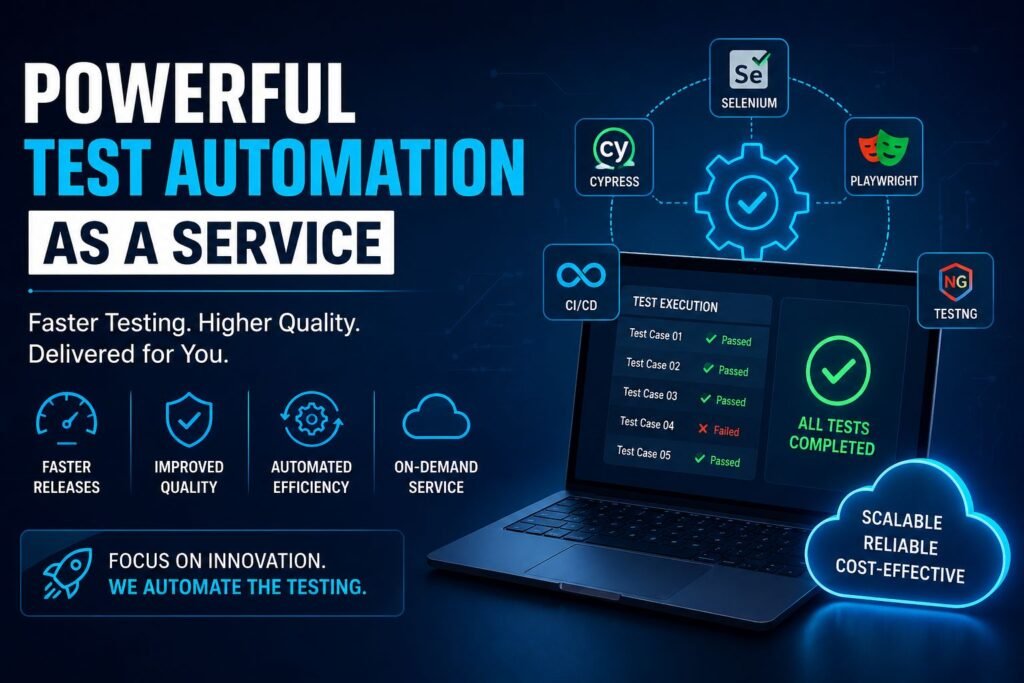
In today’s fast-paced digital world, businesses can no longer afford slow or error-prone software testing. Speed, accuracy, and reliability are critical to staying competitive and delivering seamless user experiences.
Traditional testing methods often struggle to keep up with rapid development cycles. This is where modern, scalable solutions step in to eliminate bottlenecks and improve overall efficiency.
In this article, we will explore what test automation as a service means, its importance, benefits, challenges, and practical applications, and how Tecrix.org helps businesses leverage it effectively.
Test automation as a service (TAaaS) is a cloud-based testing model where external experts provide automated testing solutions without requiring in-house infrastructure or dedicated teams.
Instead of building everything from scratch, businesses partner with a specialized software testing company to handle automation frameworks, tools, execution, and reporting. This approach allows organizations to focus on development while ensuring high-quality software delivery.
With test automation as a service, testing cycles are significantly reduced. Automated scripts run continuously, identifying bugs early and accelerating product releases.
Hiring, training, and maintaining an in-house QA team is expensive. TAaaS eliminates these overhead costs while delivering expert-level results.
Whether you’re launching a startup app or managing enterprise software, test automation as a service scales effortlessly with your needs.
Automation reduces human error, ensuring consistent and reliable testing outcomes across multiple environments.
By leveraging QA outsourcing, businesses avoid infrastructure and staffing expenses while accessing top-tier expertise.
A professional software testing company uses the latest automation tools, frameworks, and technologies—saving you from costly investments.
Test automation as a service integrates seamlessly with CI/CD pipelines, enabling continuous testing and faster feedback loops.
Automation allows testing across multiple devices, browsers, and platforms simultaneously.
Teams can concentrate on innovation and product development while experts handle quality assurance.
Consider an eCommerce company launching frequent updates. Manual testing delays releases and increases the risk of bugs.
By adopting test automation as a service:
This is a practical test automation as a service example that highlights efficiency and scalability.
Although outsourcing simplifies processes, defining requirements and workflows may take time initially.
Not all tools integrate easily with existing systems, requiring expert guidance.
Businesses must ensure secure handling of sensitive data when opting for QA outsourcing.
Clear collaboration between internal teams and service providers is essential for success.
| Aspect | Traditional Testing | Test Automation as a Service |
|---|---|---|
| Speed | Slow | Fast & Continuous |
| Cost | High | Cost-effective |
| Scalability | Limited | Highly scalable |
| Accuracy | Manual errors | High precision |
| Maintenance | In-house effort | Managed externally |
Ensures websites perform smoothly across browsers and devices.
Automates testing for Android and iOS platforms with high accuracy.
Validates backend services and integrations efficiently.
Automatically re-tests existing features after updates.
Evaluates system performance under different loads.
Many businesses rely on a test automation as a service pdf guide to understand implementation strategies, workflows, and ROI expectations.
These resources help decision-makers:
Teams release features quickly without compromising quality.
Bug-free applications lead to higher user satisfaction and retention.
Businesses using test automation as a service outperform competitors relying on manual testing.
Detailed reports provide insights for continuous improvement.
When selecting a partner for test automation as a service, consider:
A reliable software testing company becomes a long-term growth partner.
Test automation as a service is no longer optional—it’s a strategic necessity for businesses aiming to scale rapidly and deliver high-quality software. By outsourcing testing to experts, companies gain speed, efficiency, and a competitive edge without heavy investments.
If you want to streamline your QA processes and boost your product quality, adopting test automation as a service is the smartest move forward.
The four pillars are strategy, tools, test data, and skilled resources working together to ensure reliable automation.
QA as a service is an outsourced model where companies hire external teams to handle software testing and quality assurance on demand.
No, AI will assist QA and SDET roles by automating repetitive tasks, but human expertise is still needed for strategy and complex testing.
ATF (Automated Test Framework) is a built-in tool in ServiceNow used to automate testing of applications and workflows.
The salary varies by country, but ATF testers typically earn competitive pay depending on experience and demand.
The main types are unit testing, integration testing, system testing, and acceptance testing.