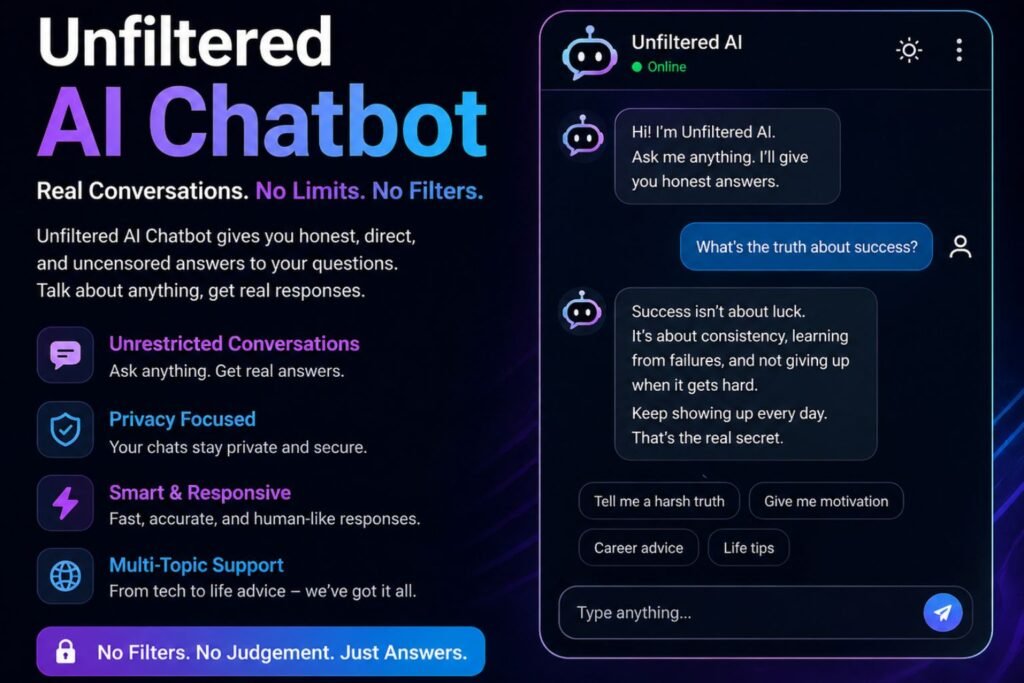
Businesses are rapidly adopting AI-driven communication tools to enhance user engagement and automate interactions. Among these innovations, unfiltered conversational systems are gaining attention for their flexibility and responsiveness.
These systems allow more dynamic and less restricted interactions, enabling unique use cases across industries. However, they also require careful implementation to ensure safety and effectiveness.
In this article, we will explore what unfiltered ai chatbot means, its importance, benefits, challenges, and practical applications, and how Tecrix.org helps businesses leverage it effectively.
An unfiltered AI chatbot is a conversational system that works with fewer restrictions, allowing it to generate more open, flexible and context aware responses.
When people ask what unfiltered AI chatbots are, they usually mean systems that are not heavily limited by strict rules or predefined scripts, which enables them to handle a wider range of conversations.
These chatbots aim to create more natural and human like interactions, but they still need to be used responsibly to ensure the responses remain appropriate and useful.
An unfiltered ai chatbot allows more natural and human-like interactions without overly rigid constraints.
Users often prefer flexible conversations that feel less robotic and more intuitive.
Businesses can tailor responses for niche industries, advanced support, or creative applications.
Reduced limitations allow the chatbot to respond more dynamically and efficiently.
Unfiltered ai chatbot systems can adapt responses based on context rather than strict scripts.
AI can deliver tailored responses to different user intents and behaviors.
Businesses don’t need to predefine every possible conversation flow.
These chatbots can handle large volumes of queries simultaneously.
Companies leveraging unfiltered ai chatbot solutions often outperform competitors relying on traditional bots.
Handling complex queries with more dynamic responses improves resolution quality.
AI can help generate suggestions, ideas, and responses for users.
Used for employee support, FAQs, and workflow automation.
Provides interactive learning experiences with flexible dialogue.
Engages users in conversational campaigns that feel more natural.
Many organizations are exploring unfiltered ai chatbot in 2026 as part of their AI transformation strategy.
Examples include:
These implementations demonstrate how unfiltered AI systems can enhance both customer experience and operational efficiency.
Without proper safeguards, responses may become unpredictable.
Unrestricted outputs can sometimes generate inappropriate or irrelevant content.
Businesses must ensure adherence to data protection and industry regulations.
Continuous oversight is required to maintain quality and reliability.
Set boundaries and rules to maintain appropriate responses.
Combine unfiltered responses with safety filters for balance.
Ensure the chatbot is trained on accurate and relevant datasets.
Analyze interactions to identify issues and optimize outputs.
Maintain a human-in-the-loop system for critical interactions.
| Feature | Traditional Chatbots | Unfiltered AI Chatbot |
|---|---|---|
| Flexibility | Limited | High |
| Response Style | Scripted | Dynamic |
| Customization | Moderate | Extensive |
| Scalability | Controlled | Highly scalable |
| User Experience | Structured | Natural & conversational |
More natural conversations increase satisfaction and engagement.
Automation reduces workload for support teams.
Businesses save on staffing and operational expenses.
AI-driven insights help improve business strategies.
Encourages experimentation with new conversational experiences.
An unfiltered AI chatbot offers powerful opportunities for businesses seeking more flexible, dynamic, and scalable conversational experiences. When implemented correctly, it can significantly enhance engagement, improve efficiency, and reduce operational costs.
However, success depends on balancing freedom with control, ensuring that the system remains safe, reliable, and aligned with business goals. With the right strategy and expertise, unfiltered AI chatbot solutions can become a valuable asset in modern digital transformation.
An unfiltered AI chatbot is a conversational system with fewer restrictions on content, allowing more open-ended responses compared to heavily moderated chatbots.
Regular chatbots have strict safety filters and guidelines, while unfiltered ones allow broader responses with minimal content moderation.
They can pose risks if not properly controlled, as they may generate inaccurate, inappropriate, or misleading information.
Popular AI chatbots include ChatGPT, Google Gemini, and Microsoft Copilot, which include safety filters and guidelines.
Some users prefer them for more creative freedom, fewer restrictions, and less filtered or restricted responses.
They are generally not recommended for professional use, as businesses require reliable, safe, and compliant AI systems with proper content controls.